Each sport requires different athletic skill sets and builds. Taller people have an advantage in basketball, athletes with quick feet often find themselves playing soccer, and those with excellent hand-eye coordination excel in softball or baseball. But did you know that each position within the sports comes with different skill sets, too?
One of the most important things you can do as an athlete is figure out the role or position that works best for you, and that’s true when it comes to softball — it’s a part of your identity! When someone asks you what sport and position you play, there’s typically a lot of pride that goes into the answer, especially the second part of it.
If you’re just about to get immersed in the softball world, or you’re already a softball player and don’t think your current position best suits you, then this post is for you. We’re going to spend some time talking about each position and the particular traits/skills that are needed to be successful over the long haul.
How Many Players Are in a Softball Game?
Fastpitch softball, what most of us know and refer to as just softball, involves 9 players on the field for each team during a game. Each softball player has a specific role or position that contributes to the team’s overall performance and strategy.
How Many Positions Are There in Softball?
In softball, there are 9 key positions, each with its unique responsibilities and skill requirements. These positions are divided into infielders, outfielders, a pitcher, and a catcher.
Softball Positions
Infield Positions: Where the Action Is
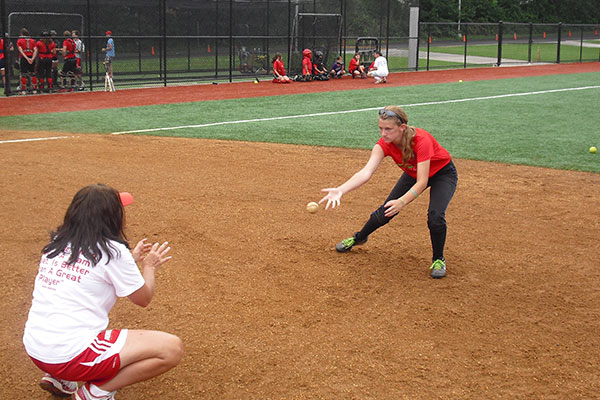
Where the real action lies is in the infield. Infielders are close to the ball and are involved in all types of plays. These players will handle ground balls, twist their bodies, throw quickly, and catch the ball to force or tag out runners. Infielders are typically among the most athletic players on youth softball teams, displaying keen awareness, agility, speed, and flexibility.
First Base
First basemen account for more outs than any player in the game and need excellent glove skills to handle throws that may be high, low, or in the dirt. Left-handed athletes have an advantage at this position because they face the pitcher and batter, making it easier to track the play and the runner. Often the best power hitters on the team, first basemen need quick reflexes for fielding pop flies and the ability to pick throws out of the dirt, while also being adept at tagging runners and hustling into foul territory.
Second Base (Middle Infielder)
The second baseman requires a sharp arm, quick reflexes, and the ability to cover lots of territory between first and second base. They field balls quickly to throw to first, cover second on steal attempts, and act as relay players from the outfield. Second basemen are often known for their fielding skills rather than arm strength, and are usually fast, agile contact hitters who excel at turning double plays.
Shortstop (Middle Infielder)
Shortstops are typically the best athletes on the team and team leaders in communication, ability, and skill. They’re the hardest working infielders because so many balls from right-handed hitters come their way, requiring a strong throwing arm, excellent range and agility, and the defensive skills to cover lots of territory. As the defacto leader of the infield, shortstops need strong leadership skills and field vision to see plays unfold and make the right decisions.
Third Base
Third base is called the hot corner because balls fly off the bat fast, making fearlessness essential. Third basemen need an arm as strong as the shortstop’s to whip the ball across the diamond, and they typically hit for more power at the plate. They also cover balls hit down the left field line into foul territory.
Outfield Positions (Outfielders)
Left Field
The left fielder covers the left third of the outfield, catching fly balls, backing up third base, and fielding hits that get past the infielders. Throws from left field aren’t usually too long, so it’s not necessary to have more than an average arm, but that makes it all the more important to be a good fielder. Speed also isn’t a huge factor, meaning there’s a greater focus for a left fielder on being one of the team’s better power hitters as well.
Center Field
Great center fielders have a lot of speed and are very good at tracking down fly balls since they typically have the most ground to cover. A strong throwing arm is necessary to throw to the infield, especially at third base and home plate. This strength also means center fielders may turn into successful slap hitters in the batter’s box.
Right Field
Right fielders are typically known for having the strongest outfield arm because they need to toss the ball all the way to third base. They’re typically not as skilled as the center fielder, but they are still skilled at tracking down fly balls. There’s also an expectation for having decent speed and being a modestly powerful hitter at the plate.
Pitcher
Pitchers are essential to a good softball team because it’s incredibly hard to be consistently successful without a skilled pitcher, as they’re in control of the game’s pace. Some skills and character traits shared by many softball pitchers include the following: mentally tough, good under pressure, ability to have an athletic delivery that’s repeatable, and they’re very competitive with natural leadership tendencies.
Catcher
Being a catcher is mentally and physically draining, especially in the middle of summer. Catchers must have strong legs that can withstand constant squatting throughout a season. The catcher is primarily responsible for foul balls hit directly behind home plate, and hitting skills are a plus but less of a requirement. Because they must be in sync with the pitcher, they need to have a strong arm to go along with excellent hands and receiving technique, and they must have tight footwork as they maneuver themselves behind the plate.
Ready to take your softball game to the next level this summer? Find a Revolution Softball Camp near you and register today!